
How to Search Civil Dockets
re:SearchTX is the statewide doorway to public Dimmit County civil dockets. Begin with the exact cause number. If you lack it, run a party-name search. Then narrow by Dimmit County, court, filing date, case type, judge, or attorney. Case Details can list parties, counsel, and status. Filings, documents, hearings, and disposition appear when the local court feeds them in.
Court level matters more than wording. District civil and family cases route to the District Clerk. County civil, probate, guardianship, and mental-health files go to the County Clerk. Small-claims and minor civil cases sit with the right JP precinct. Treat a statewide result as an index. It is not a certified clerk record.
- Identify the type of dispute and the most likely Dimmit County court level.
- Gather the cause number, public case style, party name, and likely filing year.
- Search Cases in re:SearchTX and apply county, court, civil or family, and date filters.
- Open Case Details and compare parties, status, filings, hearings, orders, and disposition.
- Contact the correct clerk or precinct for a public copy, certification, or an item missing online.
Dimmit Civil Docket Court Levels
There is no single Dimmit County docket for "civil." The Texas trial-court guide splits the work. District court holds title-to-land suits, divorce, larger civil claims, and unassigned matters. The 293rd and 365th District Courts serve Dimmit County through a regional structure. The constitutional County Court takes county-level civil work, and Justice Courts hear small claims and minor disputes.
That split decides both the clerk and the file. The Dimmit County District Clerk keeps district civil, family, and juvenile records. The Dimmit County Clerk holds County Court civil, probate, guardianship, mental-health, and other county matters. Justice courts keep their own precinct records. Compare them side by side:
| Matter | First custodian | Search caution |
|---|---|---|
| District civil, land title, divorce, family | District Clerk and re:SearchTX | Family and juvenile limits can restrict detail. |
| County civil, probate, guardianship | County Clerk and re:SearchTX | Protected medical or financial material may be withheld. |
| Minor civil or small claim | Correct JP precinct | Do not default to the County Clerk. |
| Federal civil complaint | Western District PACER/CM-ECF | It is outside the Texas state docket system. |
What a Civil Docket Shows
Every Dimmit County civil docket pairs a case header with a dated register of actions. The safe field inventory covers court and location, cause number, case category and type, filing date, status, assigned judge, party roles, attorneys, service, pleadings, motions, orders, hearings, disposition, and appeal events. A neutral code such as CAUSE NUMBER AS ASSIGNED keeps you from assuming a local number format the court may not use.
| Case header | Court, location, cause number, civil type, filed date, status, and judge when supplied. |
|---|---|
| Parties and counsel | Plaintiff or petitioner, defendant or respondent, intervenor, estate role, guardian, and attorneys where public. |
| Service and pleadings | Original petition, answer, counterclaim, service return, waiver, intervention, and other filed papers. |
| Motions and settings | Motion title, notice, hearing date and type, continuance, order, mediation, or other event. |
| Result and review | Settlement, dismissal, judgment, post-judgment motion, appeal notice, clerk's record, mandate, or release. |
A docket line that reads "motion filed" proves only a filing, never a ruling. A dismissal label alone leaves open whether it was with prejudice, without prejudice, or on terms. Pull the linked order when one exists, and confirm the exact effect with the Dimmit County clerk before relying on it.
Search Dimmit Civil Cases First
The re:SearchTX guide lists four main modes: Cases, Filings, Text in Documents, and Hearings. Left-side filters, advanced search, and result sorting are covered too. So are Case Details. Cause number is the cleanest key. Names vary or belong to more than one person. A wildcard can widen a partial name. Broad terms may pull unrelated Dimmit County results into the mix. The statewide portal view shows the landing page a searcher first meets.
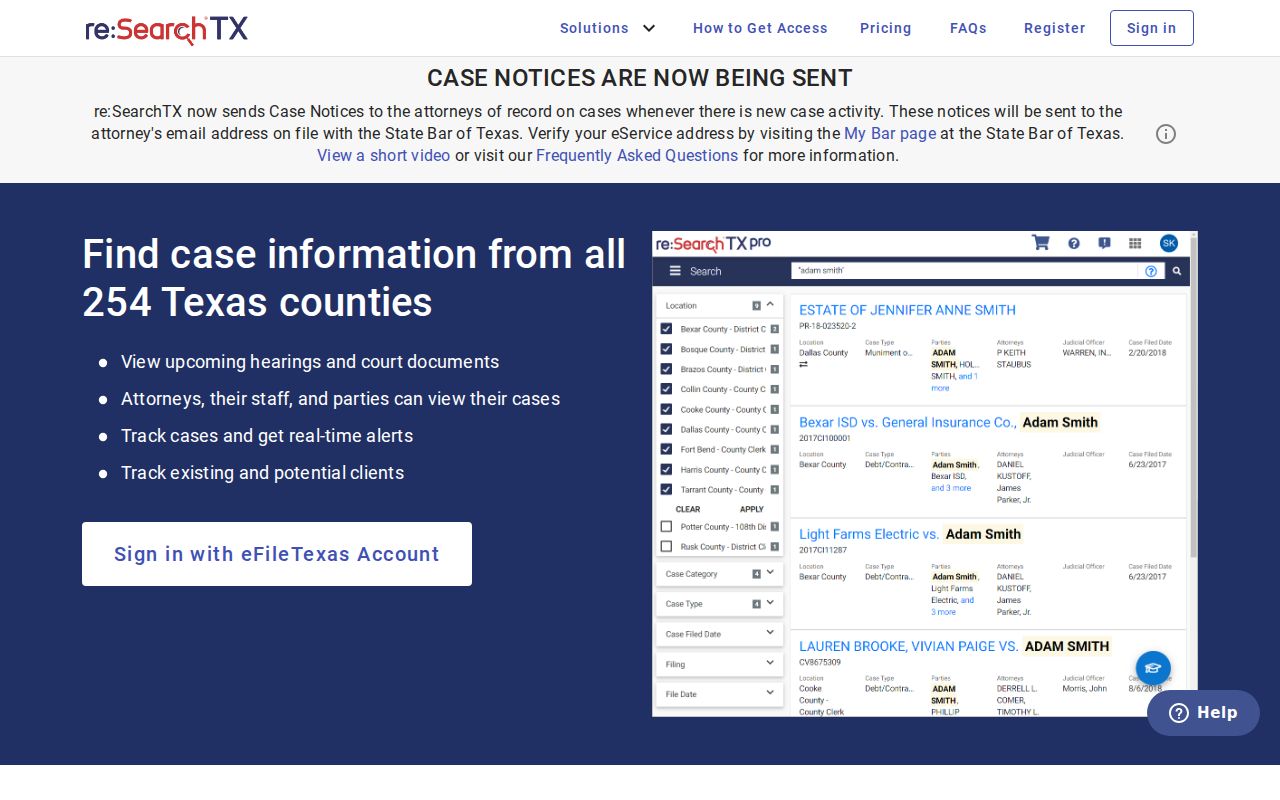
Account access matters. Saving a search, adding a case to a folder, setting an alert, sharing a case, filing into a case, or buying an available document may all require signing in. eFileTexas credentials work, but eFileTexas is the filing service rather than the public docket search.
Note: what appears online depends on local integration and public access, so a result may not include every Dimmit County pleading or exhibit.
Types of Civil Cases on the Docket
Dimmit County civil records cover far more than two-party lawsuits. Jurisdiction decides where the docket lives. A broad "civil" label does not. The District Clerk directory tags civil and family case types. The County Clerk directory tags county civil, juvenile, probate, and mental-health categories. Justice Courts keep their own small-claims work. It also covers lower-value civil cases.
- General civil claims, including contract or tort matters within the court's jurisdiction.
- Title-to-land cases and other district matters assigned by Texas law.
- Divorce and family cases, subject to privacy and restricted-document rules.
- County civil, probate, guardianship, and mental-health proceedings held by the County Clerk.
- Minor civil disputes and small claims filed in the correct Dimmit County JP precinct.
A probate case is a different record from a recorded will, deed, or vital record. A land lawsuit likewise stands apart from the County Clerk's real-property recording index. Use the court case for pleadings and orders. The recording system covers only the instrument itself.
Dimmit Civil Citation Notices
Texas runs a separate Citation and Notice Search for public legal notices. It can surface a notice tied to a civil, family, probate, or other proceeding. It is not the whole Dimmit County civil docket. Fields cover court, county, city, case number, date ranges, party, and publication details, with wildcard instructions for some searches. The official form shows the statewide notice-search fields. Those can round out a civil case lookup.
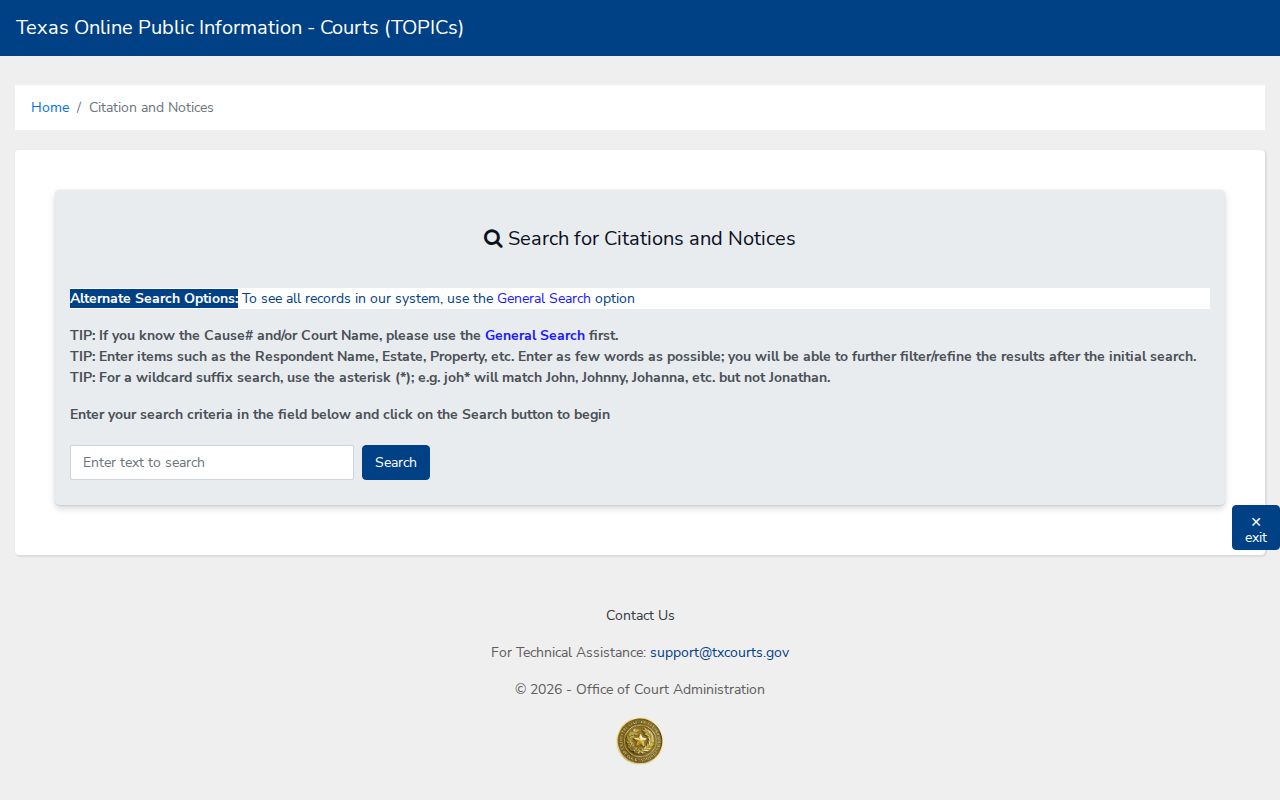
Match any notice result against the court, cause number, dates, and case style in re:SearchTX or the clerk's file. A publication notice proves nothing more. Later filings, hearings, or judgments may not appear there at all.
Settings and Hearings on Civil Dockets
When a civil setting appears in Hearings mode or inside Case Details, capture the details. Write down the Dimmit County court, the location, the judge, the date and time. Include the courtroom if listed, the case number, the public style, and the setting type. The filed Notice of Hearing still matters most. A later reset notice can change everything, so read that too. The 293rd District Court says its online records can show status and upcoming dates. Yet the formal notice remains crucial.
A petition opens a claim. A hearing gives the court a set time to work one issue. A judgment records the enforceable decision. Each is a distinct docket event. A reset or continuance moves a setting; it does not dismiss the case. Portal dates can lag behind a mailed notice. Confirm any conflict with the District Clerk, County Clerk, or proper JP office. The full scheduling workflow is laid out in the Dimmit County court calendar.
Remote instructions often ride inside the hearing notice itself. Texas's electronic-hearing material says open courts may run remote or hybrid hearings. Do not assume a public replay exists. Follow the directions sent for the specific case.
Dimmit Civil Rules and Forms
The Texas Judicial Branch maintains a local-rules and forms search. It stays narrow. It is not a civil docket. Choose a court group, court type, county, and other court identifiers. That pulls up the governing material. A local rule can explain Dimmit County filing and setting practice. Use it for procedure. No rules search, though, will show whether a motion was filed in one case. The official page shows the controls used to narrow rules and forms for Dimmit County.
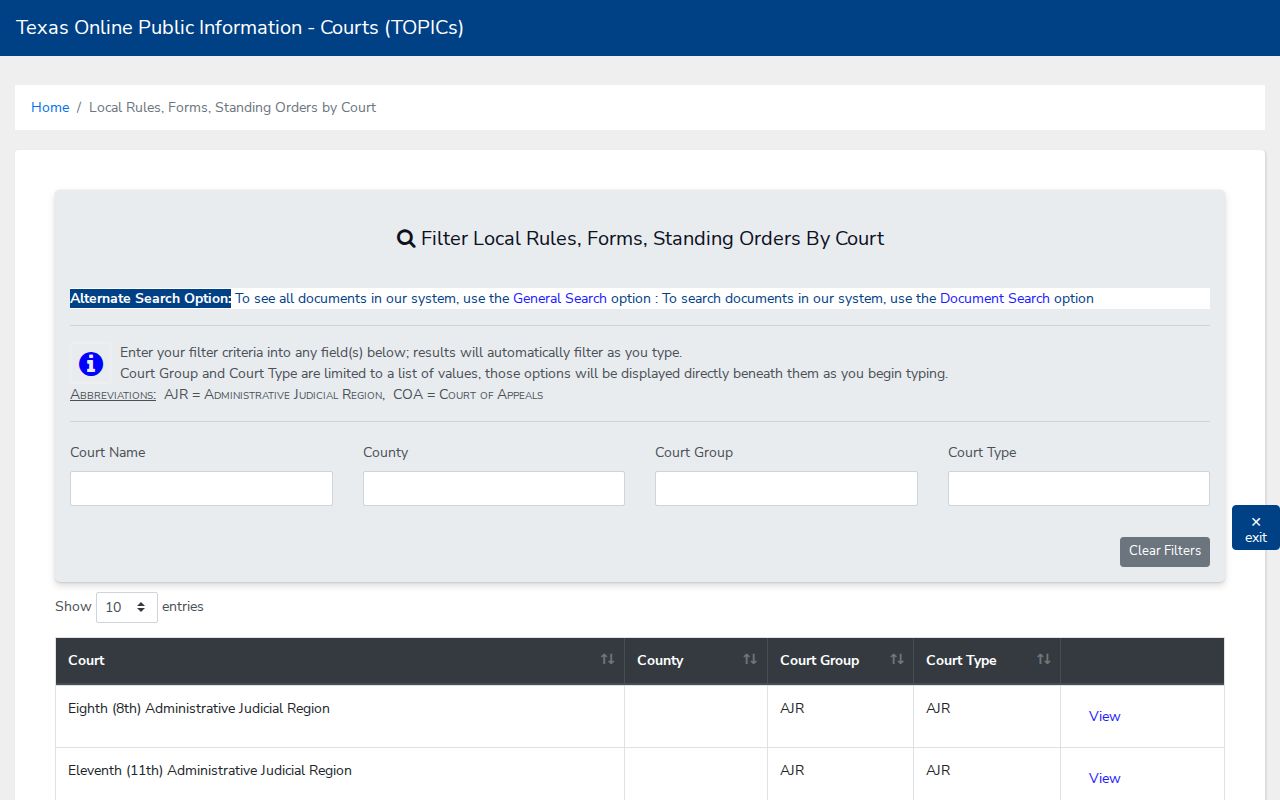
Search the rules first. That answers procedure only. The docket and the clerk still hold the actual case event, and that habit keeps a general court form from being mistaken for a filed paper in a Dimmit County matter.
Dimmit Civil Land Case Records
A deed index and a land lawsuit answer different questions. The County Clerk records real-property instruments. A title-to-land suit, by contrast, is a district civil case, so pull its pleadings and orders from the District Clerk or re:SearchTX. Use the County Clerk recording index only for the separate instrument.
Dimmit Civil Probate Dockets
The County Clerk directory tags probate, guardianship, mental-health, and county civil work. Treat that label as a routing clue. It does not prove every filing appears online. Ask the County Clerk which public case layer exists, and whether a protected medical or financial document is redacted or withheld by law.
Dimmit Civil Docket Appeals
A notice of appeal opens appellate review. It is not the decision. Later rows may name the clerk's record, a bond or supersedeas matter, and a mandate, and eligible Dimmit County district civil appeals route to the Fourth Court of Appeals in San Antonio. Read each field in sequence.
Public Access to Civil Dockets
Texas treats judicial records differently from executive-agency records. The Public Information Act does not apply the same way. Government Code Section 552.0035 points to Supreme Court rules and other law instead. Under Texas Rule of Judicial Administration 12, judicial records are generally open for inspection and copying during regular business hours. That openness holds unless an exception applies. The rule also covers written requests, redaction, costs, denial reasons, and appeal.
Rule 12 is not a master key. Records controlled by a statute, court rule, or order may be excluded. Family, juvenile, guardianship, and mental-health material can be limited. So can protected identifier data. A Dimmit County clerk may hold a case copy while the court or judge serves as custodian for a different judicial record. Ask for redirection when the office you reach is the wrong one.
Key rules:
Texas Rule of Civil Procedure 76a sets a public-interest process and required findings for sealing court records within its scope.
Texas Family Code Chapter 58 supplies confidentiality and sealing context for juvenile records.
Texas Government Code Chapter 552 remains relevant to nonjudicial county administrative records and protects information made confidential by law.
Partial Dimmit Civil Docket Files
A public case header is not the whole file. re:SearchTX may show a cause number, the case status, public parties, and an event title. It may hold back an attachment, charge for it, or list no linked document at all. Family and probate records deserve extra caution. They can hold protected personal, medical, or financial data. Rule 76a governs sealing in covered civil settings. Other statutes or orders can restrict access too.
When an exhibit is missing, write down its docket title and date first. Then ask the District Clerk, County Clerk, or JP custodian whether a public redacted copy exists. Ask whether a sealing order or some other restriction applies, and what copy fee is due. Put any request in writing. It should give the court, the cause number, the exact item, the date range, a certified or ordinary copy preference, a delivery method, and contact details.
Document retrieval on re:SearchTX may use a cart. The governing order sets a $0.10-per-page framework with a $1 minimum per document for listed licensed-attorney and registered-user groups. It also states legal-aid exemptions. Remember that a statewide screen is not a certified copy. Certification comes only from the clerk holding the Dimmit County civil record.